FitHer / Sticking with a plan
Sticking with a plan
How to stay consistent with diet and exercise when your life is full
You stay consistent by building a plan that fits your real life, including the hard weeks, and by aiming for 80-90% instead of perfect. Most women who keep falling off were handed a plan that only works on a calm week, and the first sick kid or work deadline knocks it over.
If you're starting over every Monday, I've been there. For 10+ years I convinced myself I didn't have enough willpower or discipline, when it was my plan that was too restrictive, too extreme, and never built to fit my real life.
I'm Lindsay Clements, a Certified Nutrition Coach, Certified Personal Trainer, and Navy veteran, and I coach women online through FitHer. I've worked with 300+ women, a lot of them spread thin with demanding jobs, kids, caregiving, and full calendars, and every one of them gets a plan for a normal week, a plan for a crazy week, and a plan for when she's fallen off and needs help getting back on.
★★★★★ 5.0 on Google from 49 reviews · 300+ women coached
Why can't I stick to a diet?
Usually because the diet asked for more than your life had room for. A plan that needs perfect meals, an hour at the gym, and nothing going wrong lasts until the first week something goes wrong.
"Every diet works for a few weeks, then I fall off and feel like a failure." I hear that line, or something close to it, on so many calls. These women have done the very low calorie plans, the extra cardio, the 30-day challenges, and they've decided the common thread is them.
When we look at what actually happened, the plan was too restrictive to live on, so it broke, and she blamed herself. With my clients, I start by finding out where your calories and protein actually are and what a normal week looks like for you. Then we build from there, foundations first.
How do I stop the all-or-nothing mindset?
Stop scoring your weeks as pass or fail and start counting what you actually did. With my clients, 80-90% consistency is the target, and it's plenty to see results.
Say you've got ten things on your list. Water, protein, steps, sleep, your lifts, and so on. It's a crazy week and you hit five. Your brain files that week under FAILED, right next to the weeks you did nothing at all. But five is more than zero!! Something is better than nothing, every single time.
What sets you back is the "screw it" that comes after. The week's already ruined, so you skip the walk, stay up scrolling until midnight, and promise yourself you'll start over Monday, and two off days turn into five.
Keep your bar high. I actually love that about the type-A women I coach. Just let the fives count too.
I start over every Monday. How do I break the cycle?
Come back at your next meal instead of next Monday. Eat your normal breakfast with protein, get your steps in, and move on, with no skipped meals or extra cardio to make up for anything.
The Monday restart usually starts with the scale. You weigh in after a weekend away, the number is up, you panic, and you spend the week eating as little as possible to "fix" it. That jump isn't fat. To gain one pound of fat you'd have to eat about 3,500 calories ABOVE what you burn, so it's mostly water, salt, and food that hasn't left your body yet.
Under-eating all week usually ends in the pantry by Friday, and then Monday starts it all over. I lived in that loop for years. So with clients, we look at weekly averages, never one weigh-in, and after a weekend away you go back to your normal plan, not a stricter one.
How do I fit workouts into a full schedule?
Make them shorter and do them more often. A 20-minute workout counts, and for a lot of women it's the one that actually happens.
That's why I built the FitHer Daily 20: strength workouts of 20 minutes or less, at least 5 days a week, at home with a set of dumbbells. Shorter workouts done more often build the HABIT first, and once the habit sticks we have something to build on. You still get a warm-up, real lifts with a rep range, and a plan to add weight over time. There's just less of it per day.
If you have a gym and more time, we have full gym and at-home strength programs too. But the hour-long plan you keep rescheduling has had its chance 😅
What should I focus on when I don't have time for everything?
Calories first, then protein, then steps, then strength. That's the order I give clients who are spread thin, so the most important thing never gets buried under ten smaller ones.
Calories are king for fat loss, so getting close to your target comes first. Protein comes next because it keeps you full and protects the muscle you're working for. Then steps, 7,000+ a day, where a 5-10 minute walk after meals adds up faster than you'd think. Then strength training 2-4 times a week, even if some weeks that's two Daily 20s.
Sleep sits under all of it. It's usually the FIRST thing to go when life gets busy, and then we wonder why cravings are through the roof. And no, you won't get twelve new habits in week one. We pick the one that will make the biggest difference for you right now and get it consistent first.
What are bare minimum goals for a hard week?
Bare minimum goals are the smallest version of your plan that you can still hit on your worst week. Seasons for a reason: some seasons are for fat loss, and some are for getting through a move, a new baby, a parent who needs you, or the end of a quarter at work.
On a normal week you might log all your food, get protein at every meal, lift 3 times, and hit your full step goal. On a crazy week, your bare minimums might be protein at breakfast, logging what you can, and one walk. A rough estimate in your food log is still SO much better than nothing.
Your bare minimums belong to you, so you pick them and I help keep them small enough to hit. We set them ahead of time, so a hard week doesn't shelve everything until things settle. Your health gets to stay on the list, even when it isn't #1 right now.
Do I need an accountability coach?
If you know what to do and still drift when nobody's checking in, a coach is often what's missing. Most of my clients could already tell you what to eat. What they want is someone looking at their numbers every week and telling them exactly what to focus on next, so they can just execute.
On FitHer Coaching and FitHer Custom, your check-in shows up in the app Sunday evening and it's due Monday at 8pm. I look at your weekly averages, workouts, sleep, and energy, and we set a couple of things to focus on. When a week goes sideways, the check-in is where we switch you to your bare minimums, before a missed week turns into a missed month.
You're also in our group chats with women in the same season, and it's a lot harder to fall off when they're cheering you on.
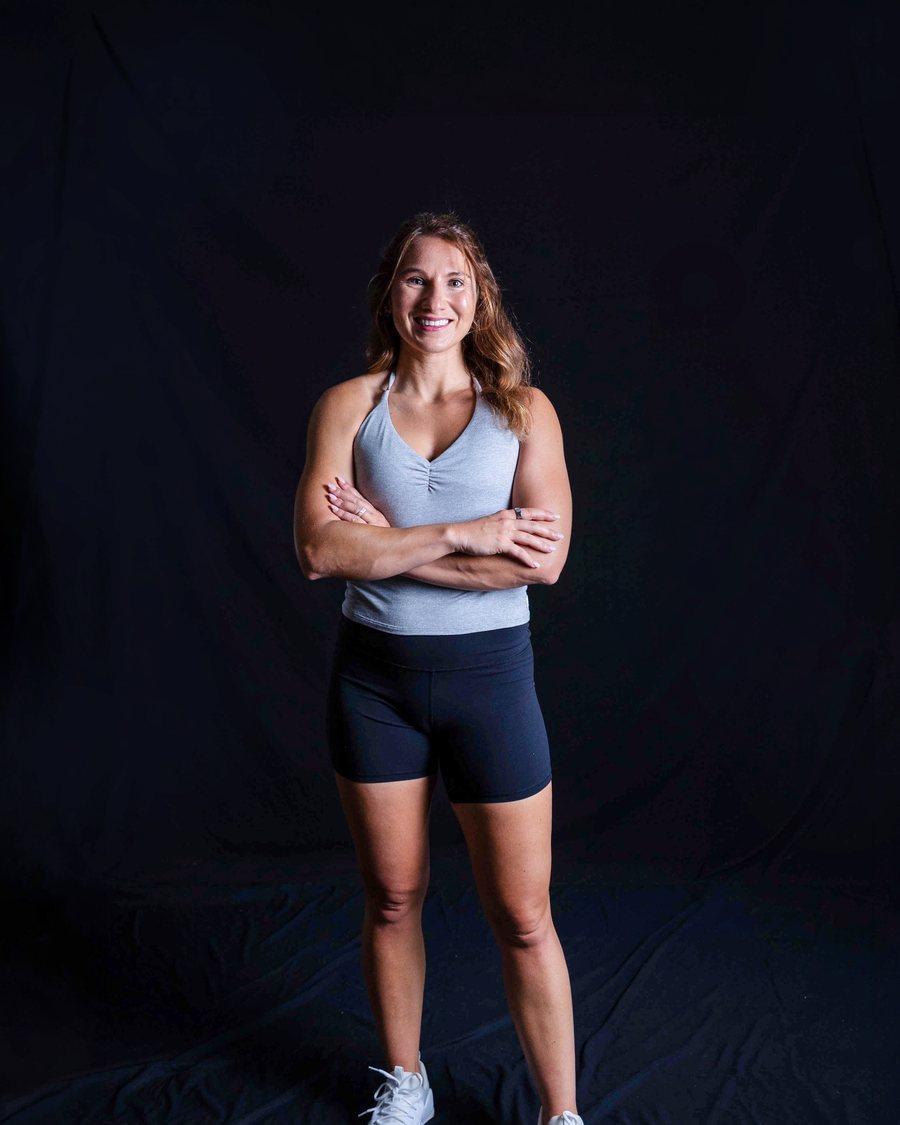
Written by Lindsay Clements
I'm the coach behind FitHer. I've coached 300+ women online over the last 5+ years, and I healed my own binge eating and postpartum metabolism issues before I ever coached anyone else.
Functional Nutrition and Metabolism Specialist · Certified Nutrition Coach · Certified Personal Trainer · M.S. in data analysis · U.S. Navy veteran (12+ years)
How we work on this in FitHer
Every FitHer program runs on the same three phases, and consistency gets built in the first one. In Foundations, we find out where your calories and protein actually are, set your bare minimums, and get you hitting your steps and your strength program (FitHer Gym, FitHer Home, or the Daily 20). Most clients spend a minimum of 4-6 weeks here. We only move into Progress & fat loss once those habits are steady, and Reverse & maintain brings you back up to maintenance so you keep your results.
On FitHer Coaching and FitHer Custom, you check in every week and I adjust the plan to the season you're in. We don't change your numbers during a super stressful week, during travel, or when you're hitting your targets less than 80% of the time. FitHer Self-Guided gives you the app, your program, the course, and the group chats if you're good at keeping yourself going.
What women say
"Lindsay has helped me so much when it comes to battling my all or nothing mentality and has helped me realize that I can enjoy life while taking care of my mind and my body too. It doesn't have to be extreme and hard to stick with."
"Lindsay keeps me accountable for the things I know are good for me but need a little push to do. She's helped me stay consistent through four moves, three of which were international."
"...I am literally eating what I enjoy but making day to day adjustments to meet my protein/calorie goals. When obstacles come up, we develop a plan that works for me in the moment, guilt-free!"
Questions I get a lot
Should I wait until life calms down to start?
Totally get not wanting to start in the middle of a crazy season. Life rarely calms down on its own, so we plan for the hard weeks instead. On those weeks we set bare minimum goals, and the Daily 20 workouts take just 20 minutes a day.
Do I have to track my food perfectly?
No. We aim for 80-90% consistency, and a rough estimate is still SO much better than nothing. Tracking is a tool we teach so you learn how to fuel your body, and the goal is always food freedom.
Which FitHer option is best if I need accountability?
If weekly check-ins are what keep you going, FitHer Coaching is where most women start. I look at your numbers every week, we adjust together, and we get on a private call once a month. You can take the 3-question quiz on the homepage if you're not sure.
Do you coach women online?
Yes. FitHer is fully online through the Trainerize app, where your workouts, food logging, check-ins, and the group chats with the rest of the FitHer ladies all live. Programs work at home or at the gym.
What does FitHer cost?
FitHer Self-Guided is $99 a month, FitHer Coaching is $279 a month with weekly check-ins, and FitHer Custom is $349 a month with a training plan built only for you. Self-Guided is month to month, and Coaching and Custom have a 4-month minimum, then go month to month.
Can I use my HSA or FSA?
You may be able to. FitHer is HSA/FSA eligible through Truemed, and you can check whether you qualify before you sign up.
Want a plan that fits the week you actually have?
Book a free call and tell me what your weeks really look like. We'll figure out where to start and which FitHer option fits the season you're in.
More from FitHer
FitHer is nutrition, training, and habit coaching, not medical care. If you have a medical condition, an injury, or a history of disordered eating, talk with your doctor before changing how you eat or train.