FitHer / Perimenopause & menopause
Perimenopause & menopause
Perimenopause and menopause weight loss coaching for women who are done dieting
Yes, you can lose weight in perimenopause and menopause. What usually stops working is the approach you used at 28, because shifting hormones, worse sleep and more stress make your body hold on tighter, and eating less with more cardio on top tends to make that worse.
What works for my clients in this season is eating ENOUGH, protein and fiber first, strength training, sleep, and fat-loss phases with an end date. If the foundations are in place and something still feels off, we look at labs.
I'm Lindsay Clements, a Functional Nutrition and Metabolism Specialist and certified coach, and I coach women online through FitHer. A lot of the 300+ women I've worked with came to me in their 40s and 50s saying their body "just stopped listening."
★★★★★ 5.0 on Google from 49 reviews · 300+ women coached
Why am I gaining weight in perimenopause when I'm eating the same?
Because "the same" food is landing in a different body. In perimenopause, estrogen and progesterone swing and then drop, sleep often gets lighter, and stress hits harder than it used to. Research shows women also lose muscle with age unless they're actively building it, and less muscle means your body burns less at rest.
Add a demanding job, a few bad nights of sleep a week and maybe a decade of on-and-off dieting, and your body is under pressure. A stressed body holds on.
There's nothing that you're doing wrong, we just have to work smarter, not harder. With clients, I start with the weekly averages: calories, protein, steps, sleep. Sometimes the answer is in there. When it isn't, labs like thyroid, iron, insulin and cortisol may suggest what else is going on.
Can you lose weight during perimenopause and menopause?
Yes. It usually takes more patience and a smarter setup than it did in your 20s, but I watch women in their 40s, 50s and 60s lose body fat and get stronger all the time.
The order matters. Every client starts in Foundations: tracking, protein, fiber, sleep, steps, and a strength program that fits her schedule, usually for at least 4-6 weeks. Once she's consistent most days (80-90% is the target, not perfection), we talk about a fat-loss phase.
That phase has an end date, with diet breaks planned in, and then we reverse diet back up to maintenance so she keeps her results. A diet that never ends is its own kind of stress. And if fat loss isn't the right call for you right now, there is absolutely NOTHING wrong with maintenance.
How many calories should a woman in her 40s eat?
There isn't one number, and I'd be wary of anyone who gives you one without knowing anything about you. It depends on your size, your muscle, how active you are, how you sleep and how long you've been dieting.
What I can tell you is that most women who come to me are eating too LITTLE. I've had clients come in after a provider put them at 1,200 calories a day. Under-eating for months tends to backfire: energy drops, hunger gets weird, workouts feel harder, sleep gets worse, and eventually the scale stops moving anyway. So you eat a little less, and it stops again.
In FitHer we set a starting number and adjust it from your weekly averages, never one weigh-in. If you've been under-eating, we usually add food slowly, about 75-100 calories at a time with protein first, before we ever talk about a deficit. Yes, that means eating MORE to eventually lose fat.
How much protein do women over 40 need?
More than most women are eating. Research shows women in midlife and beyond do better with more protein than the basic daily recommendation, mainly to hold on to muscle. The anchor I use with most clients is around 1 gram per pound of goal body weight, and we work up to it gradually.
Protein protects muscle while you lose fat and keeps you fuller, which matters when hormones make hunger harder to read. Fiber is right behind it.
Nothing is off limits. I'd rather you hit your protein with foods you actually like (greek yogurt, eggs, cottage cheese, chicken, a shake if you need it) than follow a perfect meal plan for four days and quit. Calories first, then protein, then fiber.
Should I do cardio or lift weights in perimenopause?
Lift weights. If you only have time for one thing, make it strength training 2-4 times a week, and keep walking.
Muscle supports your metabolism, blood sugar and bones as estrogen drops. A lot of hard cardio is one more stressor for a body that's already stressed, and I see so many women in this season doing an hour of it every day and wondering why nothing changes. Keep the runs or classes you love, and put lifting in front of them.
Every FitHer strength program uses progressive overload with rep ranges, and I build my training for women around research on women's physiology. We aim for 7k+ steps and a 5-10 minute walk after meals. If time is tight, the Daily 20 workouts take 20 minutes a day, and shorter workouts done more often are how the habit sticks.
How do I lose belly fat during menopause?
You can't spot-reduce belly fat, so crunches won't do it, but when you lose overall body fat the midsection comes along with it. Research shows that as estrogen drops, women tend to store more fat around the middle, which is why it can feel like it showed up out of nowhere.
The same foundations apply: enough food with protein and fiber, strength training, daily steps, 7+ hours of sleep when you can get it, and real stress support. For a lot of my clients, sleep and stress are the missing pieces.
We also stop judging progress by the scale alone. Measurements, photos, how your jeans fit and what you're lifting all count, and plenty of my clients have watched their waist shrink while the scale barely moved.
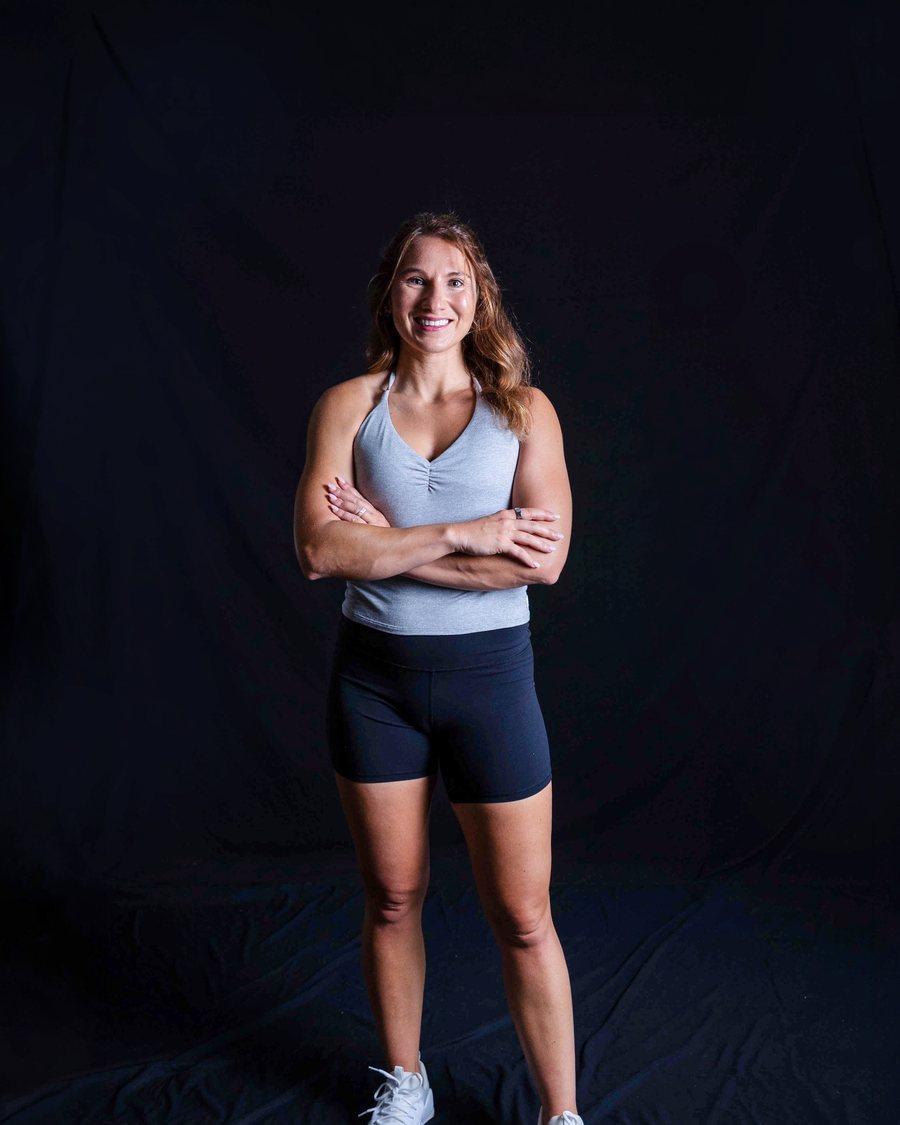
Written by Lindsay Clements
I'm the coach behind FitHer. I've coached 300+ women online over the last 5+ years, and I healed my own binge eating and postpartum metabolism issues before I ever coached anyone else.
Functional Nutrition and Metabolism Specialist · Certified Nutrition Coach · Certified Personal Trainer · M.S. in data analysis · U.S. Navy veteran (12+ years)
How we work on this in FitHer
Every FitHer program runs on the same 3 phases. Foundations builds the habits: tracking, protein, fiber, sleep, and workouts that fit your schedule. Progress and fat loss adjusts your macros and movement, with plateaus and diet breaks planned for. Reverse and maintain brings you back up to maintenance so you keep your results.
On FitHer Coaching and FitHer Custom, I review your check-in every week and we adjust together, based on your weekly averages instead of one scary weigh-in. On Custom, your strength program is written only for you and rewritten every 6 weeks.
If your hormones or metabolism feel off, you can add labs to any tier. The functional lab panel looks at hormones, thyroid, cortisol, insulin, iron and more, and I review it with you, adjust your plan, and build a protocol with supplement recommendations you can run by your doctor. This is personal for me: after my second baby my cortisol production was completely flatlined, and my labs said my body was 10 years older than I actually was.
What women say
"It's the first time I truly feel like I'm on a path that is sustainable and will stick for years to come. Not just a quick weight loss fad diet. I'm approaching 50 and feel better than I have in years!"
"A few months in, I wasn't seeing the weight loss I expected. Instead of giving up, Lindsay helped me take a deeper look at my lab work and provided nutrition suggestions based on what was going on with my body. That support made a huge difference."
"Instead of fighting against my body, Lindsay taught me how to embrace my new normal and work with it... Lindsay helped me understand the importance of balancing workout intensity with proper rest, and guided me toward a nutrition plan that reduced inflammation and supported healing."
Questions I get a lot
Is it harder to lose weight after 40?
It's usually slower, and the methods that worked in your 20s often stop working. Hormone changes, muscle loss, sleep and stress all play a part. With enough food, protein, strength training and patience, women in their 40s, 50s and 60s lose fat and get stronger all the time.
Does intermittent fasting work for women over 40?
It can work for some women, mostly because it helps them eat less overall. For a lot of women in perimenopause, a long fast stacked on poor sleep, hard workouts and a stressful job is one more stressor. I care more that you eat enough and hit your protein than when you eat, so if fasting makes that harder, it's probably not the right tool for you right now.
Does HRT help with weight loss?
Whether hormone therapy is right for you is a conversation with your doctor. I support the nutrition, training and habit side whether you're on HRT or not.
Do you coach women online?
Yes, all of my coaching is online through the FitHer app. Your workouts, food logging, weekly check-ins and the group chats all live there, and programs work with a full gym or just dumbbells at home.
What does coaching cost?
FitHer Self-Guided is $99 a month, FitHer Coaching with weekly check-ins is $279 a month, and FitHer Custom with a training plan written for you is $349 a month. Self-Guided is month to month, and Coaching and Custom have a 4-month minimum. The labs add-on is a one-time $300 on any tier.
Can I use my HSA or FSA?
In many cases, yes. We partner with Truemed, so you may be able to use pre-tax dollars. You sign up and pay as normal, take Truemed's quick survey, and if you're approved you submit your receipt for reimbursement.
Ready to stop fighting your body in this season?
Pick the level of support that fits you, or book a free call and we'll talk through where you're at and what I'd look at first.
More from FitHer
I'm a nutrition and fitness coach, not a medical provider. I don't diagnose, prescribe, or change medication or hormone therapy, so anything medical, including HRT and thyroid medication, stays between you and your doctor.